

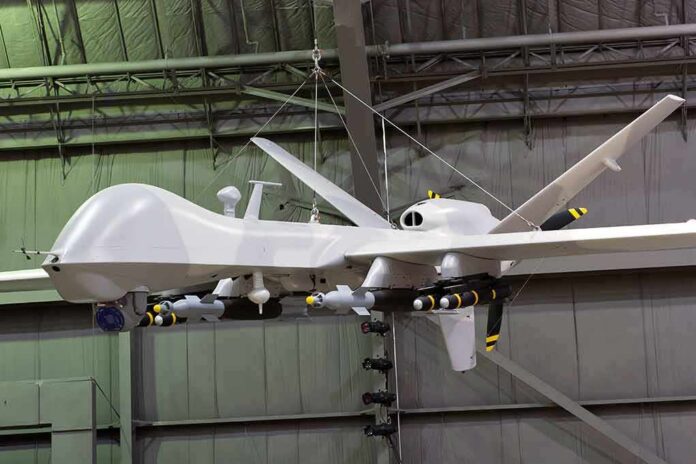
America’s first combat-ready “loyal wingman” drones are now practicing rapid wartime deployments from dusty forward strips, signaling a major shift in how the U.S. fights and wins in the air.
Story Snapshot
- The U.S. Air Force is running Agile Combat Employment trials at Creech Air Force Base with its first two combat-oriented uncrewed wingman aircraft, Fury and Dark Merlin.
- Operators are leading full ground and flight operations to see if these drones can fight from rough, remote locations with lean logistics and fast movement.
- These trials push forward a program expected to field hundreds of semi-autonomous combat drones as “loyal wingmen” for U.S. fighters by the end of the decade.
- The Trump administration’s Pentagon is betting these drones will boost American air power against China and other threats while keeping U.S. pilots out of the most dangerous missions.
Agile Combat Trials Put Fury And Dark Merlin To The Test
From July 20–24, the Air Force’s Collaborative Combat Aircraft Experimental Operations Unit is running an Agile Combat Employment exercise at Creech Air Force Base in Nevada. Military operators, not just company engineers, are handling full ground and flight operations for the YFQ-42 Dark Merlin and YFQ-44 Fury prototypes. The goal is simple and serious: prove these drones can deploy, launch, and recover from rough, limited sites while still doing real combat jobs in a fast-moving fight.
Agile Combat Employment is the Air Force’s plan to avoid having all its jets stuck at a few big, easy-to-target bases. Under this doctrine, aircraft spread out across smaller locations, move often, and keep fighting even if main hubs are hit. Testing Fury and Dark Merlin in this framework matters for patriots worried about war with China or other major powers, because it shows the Trump administration is pushing hard to keep American air power flexible, mobile, and hard to kill.
Inside The Loyal Wingman Program Taking Shape
Fury and Dark Merlin sit at the heart of the Air Force’s Collaborative Combat Aircraft program, which aims to team crewed fighters with smart, semi-autonomous wingman drones. General Atomics’ Dark Merlin delivered the first successful Air Force CCA flight in August 2025, followed by an autonomous mission flight in February 2026. Anduril’s Fury then matched those milestones, flying missions where onboard software handled key tasks without a human moving the flight stick every second.
Reports describe loyal wingman drones as extra shooters, scouts, and decoys that fly in formation with jets like the F-35, F-22, and F-15EX. They can carry sensors, electronic warfare gear, and missiles, and they can soak up enemy fire that would otherwise target a human pilot. The Air Force has talked about buying up to around 1,000 such aircraft to provide “affordable mass” in large air battles, a clear sign Washington is planning for big fights, not small police actions.
Lean Logistics, Austere Bases, And The China Threat
The Creech trials focus heavily on logistics, which conservatives know is where big Pentagon plans often fail. Fury and Dark Merlin are being tested for operations from austere locations with a tiny support footprint, often moving from strip to strip under Agile Combat Employment concepts. Designers built these drones around commercial-style parts and simple maintenance, with the aim of cutting long supply chains and slashing costs that have plagued past “high-tech” programs.
Fury Loyal Wingman Arrives At Creech AFB For Agile Combat Deployment Trials
Both of the USAF's CCAs, the YFQ-44 Fury and YFQ-42 Dark Merlin, are to be put through their paces at Creech AFB in Southern Nevada.
Anduril’s YFQ-44 Fury Collaborative Combat Aircraft (CCA) caught the… pic.twitter.com/FP6eVTxnZX— Dee Knight (@DeeKnig67666008) July 22, 2026
For a Trump-supporting audience worried about China’s growing air and missile power, this matters. Instead of pouring money into one gold-plated fighter that must sit at a huge base, the Trump Pentagon is backing distributed air power: many cheaper wingmen, spread across many locations, controlled by a smaller number of human pilots. That approach fits core conservative values—strength through smart planning, not bloated bureaucracy—and could help keep American pilots alive while still hitting hard if conflict erupts in the Pacific.
Human Control, Allies, And Guardrails For New Tech
Officials say these collaborative combat drones remain under human control even as autonomy software handles routine flight tasks and some mission work. In past tests, Fury has flown semi-autonomously, carried inert air-to-air missiles, and even launched a missile under close human supervision. That blend supports core constitutional and moral concerns: machines help fight, but human beings still make life-or-death choices, including when to fire weapons and how to avoid civilian harm.
Observers from the Royal Netherlands Air Force are on site at Creech, watching how U.S. crews run the trials. Their presence shows allies are being pulled into this new model of air warfare, but under American leadership rather than globalist bureaucracy. While many test details remain classified for security reasons, the Pentagon has been more willing in recent years to reopen weapons testing reports to Congress and the public. That trend can help patriots keep an eye on spending, performance, and whether new systems truly serve national defense instead of contractor wish lists.
Sources:
realcleardefense.com, defense-update.com, acc.af.mil, theaviationist.com, doctrine.af.mil, congress.gov, twz.com, airandspaceforces.com, plus.shephardmedia.com, govinfo.gov