

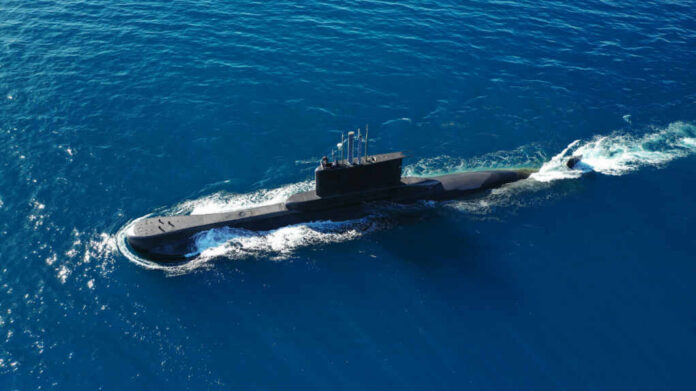
The U.S. Navy now says its ballistic missile submarines can be vulnerable on the surface, where cheap drones and anti-tank rockets could create a real problem.
Quick Take
- The Navy’s concern centers on submarines that are surfaced or moving in port, not boats hidden deep underwater.
- Defense News reports the service is looking for better ways to protect missile subs and their support sites.
- The Navy is also studying new tools to detect, track, and defeat unmanned systems in port, harbor, and open-water settings.
- Past Navy testing shows drones have already been used for logistics at sea, which makes the threat picture harder, not simpler.
Surface Transit Is the Weak Spot
Defense News reports that America’s ballistic missile submarines are “practically invulnerable” when hidden deep in the ocean, but they can be “sitting ducks” when berthed or sailing on the surface. That matters because the Navy’s warning is not about fantasy warfare. It is about the few moments when these boats are exposed and moving near shore, where drones, mines, and even anti-tank rockets could pose danger.
The article says guerrillas or terrorists along a waterway could use anti-tank guided missiles or handheld anti-tank rockets to ambush a submarine. It also says Ukraine claimed success last year with an underwater drone that damaged a Russian submarine in Novorossiysk. For readers who still think the undersea fight is settled, that should be a wake-up call. The Navy is openly searching for better ways to protect missile subs as they enter and leave port.
New Defenses Are Still in Development
The Navy’s own language shows how much work remains. According to the report, the service wants “prototype technologies” that can detect, track, identify, deny, and defeat unmanned systems across port, harbor, littoral, waterways, and open ocean settings. It is also looking for ways to escort and protect missile subs during transit to and from port. That is a clear sign that current defenses do not fully cover the threat.
The service is also asking for tools that reduce the signal trail left by submarines and unmanned systems, including acoustic, chemical, optical, electromagnetic, radiological, hydrodynamic, and cyber signatures. In plain English, the Navy wants to stay hidden and make enemy sensing harder. That is basic common sense. If a submarine has to surface or move near shore, it becomes more exposed to cheap weapons that do not cost much to field.
Uncrewed Systems Are Changing the Fight
The broader threat is not limited to one weapon. The War Zone reported that the Navy is also working on teaming underwater drones with mini-submarines carrying SEALs, which shows how fast uncrewed systems are moving into core Navy missions. The same report said underwater systems still face major communication and coordination limits, with significant hurdles before they become reliable. That means the Navy is adapting, but it is not done yet.
The Navy's ballistic missile subs are untouchable submerged — but exposed in port. After Ukraine used an underwater drone to damage a Russian sub, the Navy is fast-tracking defenses against drones, mines, and anti-tank rockets across 22 focus areas.https://t.co/3lwxSECbKa pic.twitter.com/sbQ2lsHvAn
— OmicronVis (@OmicronVis) July 8, 2026
That uncertainty matters for deterrence and for the defense of America’s sea-based nuclear force. Supporters of strong defense argue that submarines remain among the hardest targets on Earth, and other reporting says the Navy still relies on sonar and layered anti-submarine weapons to fight threats below the surface. But the surface problem is separate. A submarine that is hard to find underwater is still vulnerable when it must show itself.
Why This Warning Stands Out
This story fits a familiar pattern in military planning. The Navy often highlights new threats when technology changes faster than defenses do. Here, the threat is not some distant theory. It is cheap drones, small missiles, and port-side exposure against some of the nation’s most important warships. For taxpayers, that raises the same old question: why does Washington always seem to discover the weak spot after the new threat is already in the water?
At the same time, the report does not prove that every surfaced submarine is easy prey. It does not give test results, penetration data, or a full engineering study on anti-tank rockets versus submarine hulls. What it does show is a Navy that sees a real gap and is rushing to close it. For a force built on stealth, that is not a small issue. It is a warning sign.