

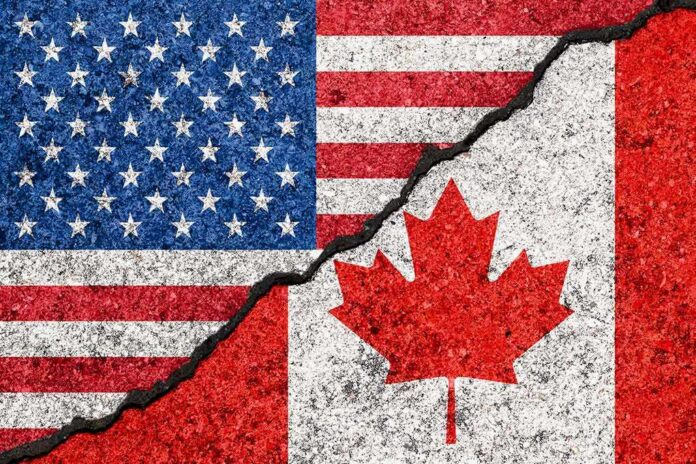
When a U.S. president reaches back nearly a century to revive a dormant tariff law, the move says as much about executive power and political leverage as it does about dairy quotas or hockey-stick exports.
Key Points
- Trump has invoked Section 338 of the 1930 Tariff Act to impose 50% duties on a wide range of Canadian goods, an authority that had effectively lain unused for generations.
- The administration justifies the tariffs as a response to Canadian discrimination against U.S. autos, alcohol, and dairy, but the public record lacks a detailed evidentiary file proving that comparative discrimination.
- The remedy is broad and symbolic—covering products from wine and cement to furniture and hockey sticks—while exempting energy and other politically sensitive sectors.
- The dispute illustrates how obscure trade statutes can become tools of hardball politics in a wider North American trade war, bypassing the usual investigative and adjudicative processes.
Section 338: A Long-Forgotten Lever of Presidential Tariff Power
To understand what Trump has done to Canadian exports, you have to start with Section 338 of the Tariff Act of 1930—a provision most trade lawyers never expected to see in active use. Section 338 authorizes the president to impose “new or additional duties” of up to 50% when a foreign country either imposes an unreasonable charge or limitation on U.S. goods not equally enforced on like goods from every other foreign country, or “discriminates in fact” against U.S. commerce. Crucially, the statute does not require a formal investigation, a public evidentiary record, or an independent agency finding before the president acts; the trigger is the president’s own finding of discrimination.
Analyses of U.S. trade law before this episode treated Section 338 as essentially dormant—so obscure that it did not appear in standard Congressional compilations of trade statutes. Commentators and trade lawyers have struggled to find any modern instance where Section 338 was used to impose tariffs in this way, which is why recent coverage describes Trump’s move as the first time this authority has been invoked to slap broad 50% duties on a major trading partner. In practical terms, Section 338 gives the president a ceiling—50% ad valorem tariffs—and wide discretion beneath it. Trump went straight to that ceiling.
The Proclamations: What Trump Actually Ordered
On July 20, Trump signed three presidential proclamations imposing an additional 50% duty on certain Canadian products, each explicitly grounded in Section 338. One proclamation targets Canadian measures affecting U.S. alcoholic beverages; another addresses alleged discrimination against U.S. motor vehicles; a third focuses on dairy measures. The White House fact sheet frames these actions as “defending American workers and ensuring fair trade,” stating that the tariffs respond to Canada’s “discriminatory treatment of American products.”
The proclamations do two important things at once. First, they formally articulate the president’s finding that Canada has discriminated against U.S. commerce in these sectors, satisfying the statutory predicate under Section 338. Second, they set the tariff rate—50% ad valorem—effective 30 days after signing, at 12:01 a.m. Eastern on August 19. Annexes to the proclamations and subsequent reporting show that the list of targeted goods extends far beyond the three named sectors. Products include wine, beer, cement, furniture, paper, plywood, clothing, wigs, and various sporting goods, including hockey sticks.
Two features stand out. The tariffs apply even to goods that otherwise qualify for duty-free treatment under the U.S.-Mexico-Canada Agreement (CUSMA/USMCA), opening a new legal and political front by cutting across the North American free trade framework. And they are crafted as additional duties, layered on top of an already complex landscape of tariffs imposed under other authorities—Section 232 national security measures on steel and aluminum, IEEPA-based “reciprocal” tariffs, and earlier rounds linked to migration and drugs.
The Discrimination Allegations Against Canada
The administration’s stated rationale is that Canada discriminates against U.S. goods in three politically sensitive sectors: motor vehicles, alcoholic beverages, and dairy. In autos, U.S. officials point to Canadian retaliatory tariffs and quotas that they say burden U.S.-made vehicles while treating other foreign vehicles more favorably. In alcohol, they highlight provincial actions—removal of U.S. products from liquor-store shelves, bans on purchase or distribution by provincial monopolies—that allegedly target U.S. beverages while leaving European or other imports available.
In dairy, the focus is on Canada’s supply-management system and tariff-rate quotas (TRQs). U.S. officials argue that quota allocations and tariff schedules provide better market access for certain partners (for example, under CETA with the European Union) than for U.S. exporters under CUSMA, and that this differential treatment crosses the line into discrimination against U.S. commerce. A U.S. Trade Representative statement characterizes provincial and federal measures collectively as “pervasive non-trade practices” that have materially reduced U.S. exports, citing an 81% drop in Canadian imports of U.S. alcoholic beverages over a recent twelve-month period.[LiveNOW transcript]
Legally, Section 338 demands more than mere unfairness in the political sense; it requires showing that Canada imposes an unreasonable limitation “not equally enforced upon the like articles of every foreign country,” or otherwise discriminates in fact so as to disadvantage U.S. commerce. That comparative element—U.S. goods versus like goods from other foreign sources—is central to any rigorous application of the statute. It is also where the public record is thinnest.
How Strong Is the Evidence of Discrimination?
The administration has provided examples and some trade data, but it has not released a comprehensive, itemized legal and factual record demonstrating that Canadian measures treat U.S. products worse than all other foreign products in the relevant sectors. The proclamations themselves assert findings in broad terms and emphasize that imposing 50% duties is “necessary and appropriate and in the public interest,” but they do not publish underlying comparative tariff tables, quota allocations, or detailed legal analysis.
Independent trade-law commentary underscores that Section 338 is triggered only when discrimination is factual and comparative, not simply when U.S. officials dislike a policy or view it as protectionist. Canada’s dairy supply management, auto surtaxes, and provincial alcohol controls are politically controversial and have already provoked U.S. complaints under other trade instruments, but controversy alone is not proof that the measures violate the specific elements of Section 338. At this stage, Canada’s public response—at least in the sources available here—focuses on opposing the tariffs as retaliatory and inconsistent with CUSMA rather than providing an item-by-item legal rebuttal deconstructing the alleged discrimination.
That asymmetry matters. Without a tribunal ruling under CUSMA, a WTO panel report, or a published Canadian dossier comparing treatment of U.S. and non-U.S. goods, the discrimination claim remains grounded largely in executive-branch assertions rather than adjudicated findings. Trade lawyers have suggested that Canada could strengthen its position by releasing comparative legal memoranda on provincial alcohol rules, detailed records on auto import treatment, and granular analyses of dairy TRQs—but those materials are not yet in the public record. In the meantime, the White House’s framing has dominated early coverage, shaping perceptions before a full evidentiary record emerges.
The Breadth of the Tariffs and the Politics of Targeting
If the legal story turns on discrimination, the economic and political story turns on breadth and symbolism. The Reuters and Globe and Mail reporting, echoed by numerous outlets, describe the new tariffs as covering about $20 billion worth of Canadian goods—roughly 5% of Canada’s exports to the United States. An independent economic research firm cited in broadcast analysis notes that this amounts to about 0.6% of total U.S. imports, which is macroeconomically modest but far from trivial for affected firms and communities.
What grabs attention is not just the aggregate figure but the composition. The tariff list sweeps in wine, beer, cement, furniture, paper, plywood, electrical equipment, machinery, clothing, wigs, and ice hockey gear. Several of these items are not directly tied to autos, alcohol, or dairy disputes; they are part of what economists and political observers recognize as “retaliation politics,” where governments select goods that are economically meaningful and symbolically charged. Hockey sticks, for example, are a cultural emblem of Canada; targeting them signals escalation as much as enforcement.
At the same time, the tariffs exclude energy, potash, critical minerals, fish, and in some accounts certain categories of motor vehicles and metals subject to other duties. Those exemptions track sectors where U.S. industries rely heavily on Canadian inputs, or where prior national-security tariffs already apply. The selectivity strengthens the perception that this package is designed as strategic leverage—pressuring Canada while avoiding blowback in energy markets and integrated manufacturing—rather than as a narrowly tailored legal remedy calibrated precisely to the disputed measures.
BREAKING: Canada cancels joint opening ceremony with U.S. for the new Gordie Howe International Bridge after Trump threatened 50% tariffs on Canadian goods.
Canadians what are your thoughts on this? pic.twitter.com/GqrvLiqmZd
— Philly (@Philly_P87) July 22, 2026
Executive Discretion, Trade Law, and the North American Context
This episode is not occurring in isolation. It is part of a broader pattern in which the U.S. executive branch has revived and repurposed old trade statutes—Section 232 (national security), Section 301 (unfair practices), IEEPA (emergency powers)—to reshape tariff policy without new legislation. Section 338 is distinctive because it predates the multilateral trading system and most modern U.S. trade remedies; it reflects a 1930s approach where Congress delegated substantial tariff-setting power to the president to respond quickly to perceived discrimination.
In the contemporary North American trade war, that authority becomes another instrument in a toolkit already deployed against Canada and Mexico. Earlier in Trump’s second term, the administration imposed IEEPA-based tariffs on Canada tied to migration and fentanyl, layered 25% Section 232 tariffs on steel and aluminum, and used reciprocal-tariff threats as bargaining chips in USMCA renegotiations. Canada’s retaliatory measures—including surtaxes on U.S. consumer goods and targeted responses to steel and aluminum tariffs—set the stage for the U.S. to argue that Canadian countermeasures themselves discriminated against U.S. commerce.
Against that backdrop, the Section 338 tariffs are both escalation and experiment. They test the outer boundaries of presidential power under a rarely litigated statute, and they challenge CUSMA’s promise that covered goods would circulate largely duty-free across North America. They also reframe familiar disputes—over dairy quotas, autos, and provincial alcohol monopolies—through a lens of unilateral executive enforcement rather than negotiated dispute settlement.
Economic Consequences and Strategic Implications
Economically, 50% tariffs function as taxes on U.S. buyers of Canadian goods; they raise prices, squeeze margins, and invite substitution where alternative suppliers exist. Analysts note that U.S. inflation has already been elevated, and additional tariffs on consumer and intermediate goods from Canada will add incremental pressure, particularly for households and firms linked tightly into cross-border supply chains.[‘Surprisingly big deal’ CNN transcript] Canadian officials have been explicit that these measures raise costs “particularly in the U.S.,” and Canada has signaled willingness to negotiate but also capacity to retaliate further if necessary.[CNN transcript]
Strategically, Canada faces a choice between mounting a detailed legal and factual rebuttal—potentially through CUSMA state-to-state dispute mechanisms or WTO channels—and negotiating a political accommodation to de-escalate the fight. The more Canada can document that its dairy regime, auto surtaxes, and alcohol controls are origin-neutral or lawfully retaliatory under trade rules, the weaker the foundation for continued Section 338 tariffs appears. Conversely, the longer the U.S. president can act under broad statutory discretion without judicial or treaty-based constraint, the more normalized this style of unilateral enforcement becomes.
For businesses and investors, the lesson is straightforward: dormant trade statutes are not dead; they are latent risk. A law written in 1930, largely forgotten by practitioners and absent from standard compilations, has just been used to rewrite price structures for billions of dollars of goods in one of the world’s deepest bilateral trading relationships. In an era where trade disputes increasingly hinge on executive narrative and political calculus, understanding those old statutes—and the conditions under which they can be pulled off the shelf—has become part of prudent risk management.
Sources:
zerohedge.com, whitehouse.gov, peacocktariffconsulting.com, reuters.com, en.sedaily.com, youtube.com, axios.com, ielp.worldtradelaw.net, cbc.ca, newsmax.com, millerthomson.com, mlex.com, americanagnetwork.com, ustr.gov, x.com