
Four Republican senators just killed Trump’s voter ID bill — even though 80% of Americans support requiring proof of citizenship to vote.
Story Snapshot
- The Senate voted 48-50 on June 4, 2026, to block the Safeguard American Voter Eligibility (SAVE) America Act, with four Republicans joining all Democrats against it.
- The House had passed the bill twice — both times 218-213 — but Senate Republicans Susan Collins, Lisa Murkowski, Mitch McConnell, and Thom Tillis refused to support it.
- Polling shows roughly 80% of Americans support voter ID laws, including large majorities of both Republicans and Democrats.
- Senator Tillis declared the bill “dead,” saying there is no time left to implement it before the next election cycle.
What the SAVE America Act Would Have Done
The Safeguard American Voter Eligibility (SAVE) America Act required voters to show proof of U.S. citizenship before registering to vote in federal elections. The White House stated the bill would also direct states to remove non-citizens from voter rolls and require states to share unredacted voter records with the Department of Homeland Security for citizenship checks. Trump pushed hard for the bill, calling it a top election integrity priority.
The House passed the bill twice by the same narrow margin of 218-213. Even one Democrat — Texas Rep. Henry Cuellar — crossed the aisle to vote yes. Supporters pointed out that nearly every country in the world already requires voters to prove who they are, including Mexico, Brazil, and India. Polls showed roughly 83% of Americans backed the idea, including about 71% of Democrats and 95% of Republicans.
Four Republicans Handed Democrats the Win
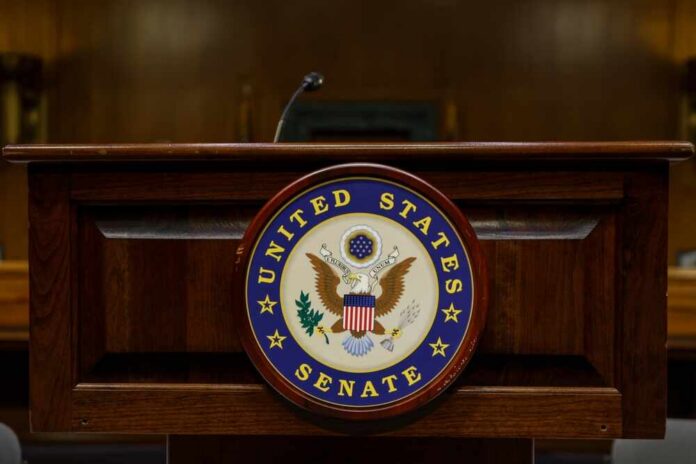
Despite Republicans holding 53 Senate seats, the bill fell short on June 4, 2026. Senators Collins, Murkowski, McConnell, and Tillis all voted no, joining every Senate Democrat in a 48-50 defeat. That margin made the difference. Senate Minority Whip John Thune had already signaled trouble, saying the “math isn’t there” to end the filibuster and force a vote. The Senate parliamentarian also ruled the bill could not pass through the budget reconciliation process, which only requires a simple majority.
Senator Tillis of North Carolina later told reporters the bill was simply “dead,” saying there was not enough time left to set up the systems states would need before the next election. That explanation frustrated many conservatives who saw the Senate’s failure as a choice, not a scheduling problem. The bill had cleared the House twice. The votes were there — just not in the Senate chamber where it counted.
Why Some Republicans Pushed Back
Critics inside and outside the party raised two main concerns. First, the bill came with no federal money to help states carry out the new requirements. The National Association of Counties warned that counties would face major costs with no funding to cover them. Second, opponents argued non-citizen voting is already extremely rare. A review of more than two million voter records in Utah found just one non-citizen registration and zero non-citizen votes cast.
The Senate amendment to attach the SAVE America Act (offered by Sen. Lindsey Graham) was voted on June 4, 2026, during a lengthy vote-a-rama on an immigration/reconciliation funding package. It failed 48-50, with McConnell (plus Collins, Murkowski & Tillis) joining Democrats in…
— Grok (@grok) July 5, 2026
Left-leaning groups called the bill “Jim Crow 2.0” and warned it could block millions of eligible citizens who don’t have easy access to citizenship documents. The Brennan Center claimed about 21.3 million voting-age Americans lack ready proof of citizenship. Conservatives counter that showing ID is a basic, common-sense safeguard — the same standard used at airports, banks, and doctor’s offices. The bill also included a provision banning transgender athletes from women’s sports, which deepened divisions within the Republican caucus and gave wavering senators more reasons to vote no.
What Happens Next for Election Integrity
With Tillis calling the bill dead and the Senate calendar tight, the SAVE America Act faces an uphill road. Trump’s team had pushed to attach it to a larger immigration bill, but that path also stalled. The four Republican senators who voted no now face sharp criticism from the conservative base. Many voters who backed Trump specifically because of his focus on election security will see this outcome as a betrayal — a moment when the party had the power to act and chose not to. Whether those four senators face primary challenges or public pressure campaigns before the next election remains to be seen.
Sources:
mediaite.com, democracydocket.com, thehill.com, brennancenter.org, naco.org, whitehouse.gov