
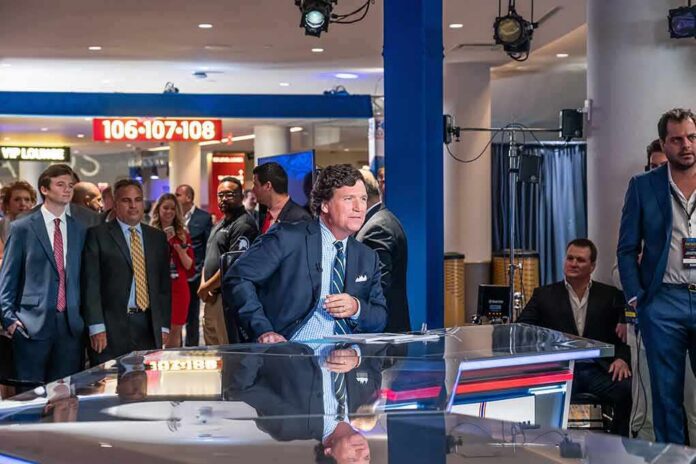
Tucker Carlson told his audience he would not vote for Michigan Republican Senate candidate Mike Rogers “at gunpoint,” while praising his Democrat rival’s platform as “literally Trumpian.”
Story Snapshot
- Tucker Carlson said he would never vote for Republican Mike Rogers and called him unfit for power.
- Carlson praised Democrat Abdul El-Sayed’s populist message as “literally Trumpian” and defended his 9/11 remarks.
- Multiple outlets called the comments a near-endorsement, though Carlson never issued a formal one.
- El-Sayed said campaigning alongside Carlson was “unlikely,” distancing himself from the media host.
Carlson Breaks With GOP Nominee Over Rogers
Tucker Carlson used his Sept. 3, 2026, show to tear into Mike Rogers, the Republican Party’s (GOP) Senate nominee in Michigan. Carlson said he would not vote for Rogers “at gunpoint” and declared that “no one should be farther from a position of power” than him. He also claimed Rogers acted as “basically a tool of Israel and the intel agencies,” tying his criticism to broader complaints about foreign policy influence in Washington.
Carlson’s remarks landed hard because Rogers ran as the Trump-endorsed Republican in a critical swing-state Senate race. A prominent conservative media figure publicly trashing the GOP nominee just weeks before voters head to the polls creates real headaches for Republicans trying to hold the seat and expand their Senate majority.
Praise for El-Sayed’s “Trumpian” Message
In that same interview, Carlson described Democrat Abdul El-Sayed’s populist-style platform as “literally Trumpian,” a comparison that stunned observers across the political spectrum. Political Wire wrote that Carlson “essentially endorsed” El-Sayed, while the New York Post later reported he had “all but endorsed” the Democrat outright. No formal, on-the-record endorsement statement from Carlson appears in the public record, but the pattern of praise left little doubt where his sympathies lean.
Carlson’s framing puts him at odds with most of the conservative movement, which has spent years warning voters about far-left Democrat policies on spending, borders, and national security. El-Sayed has campaigned as a Bernie Sanders-style progressive, making Carlson’s comparison to Trump’s America First message a hard sell for conservatives who know the candidate’s actual record.
Defending El-Sayed’s 9/11 Comments
Carlson went further on Sept. 11, 2026, publicly defending El-Sayed after backlash over remarks about the September 11 terrorist attacks. Carlson wrote that El-Sayed “did not celebrate airplane hijackings or cheerlead Al-Qaeda,” and argued El-Sayed was “obviously right” to say America’s own military response to 9/11 amounted to “terrorism” of its own. That defense drew sharp pushback from conservative outlets including Townhall and the Daily Wire, which cast Carlson’s stance as excusing dangerous rhetoric about a national tragedy.
For many conservatives, downplaying America’s post-9/11 response while defending a Democrat candidate crosses a clear line. The attacks killed nearly 3,000 Americans, and framing the nation’s military response as morally equivalent to terrorism disrespects the victims and the troops who answered the call afterward.
El-Sayed Distances Himself From Carlson
Despite Carlson’s public support, El-Sayed has not embraced a partnership with the media host. When asked directly whether he would campaign alongside Carlson, El-Sayed responded that doing so was “unlikely,” according to a transcript of the exchange. That answer suggests El-Sayed recognizes the political risk of being seen too close to a figure now feuding openly with the Republican Party over the Michigan Senate race.
Tucker Carlson: “Your typical Fox News viewer is likely oblivious to this, but America’s response to 9/11 blew the original attack out of the water.”
Tucker Carlson has inserted himself into Michigan’s U.S. Senate race, on the side of progressive Democrat Abdul El-Sayed,…
— Legal Insurrection (@LegInsurrection) September 14, 2026
The episode highlights a growing rift inside conservative media over foreign policy and loyalty to the Republican ticket. Voters in Michigan and beyond are left weighing whether Carlson’s critique of Rogers reflects legitimate policy disagreement or a costly distraction that could hand Democrats a Senate seat Republicans need to hold.
Sources:
mediaite.com, washingtontimes.com, justthenews.com, nypost.com, thedailybs.com, facebook.com, youtube.com, politicalwire.com