

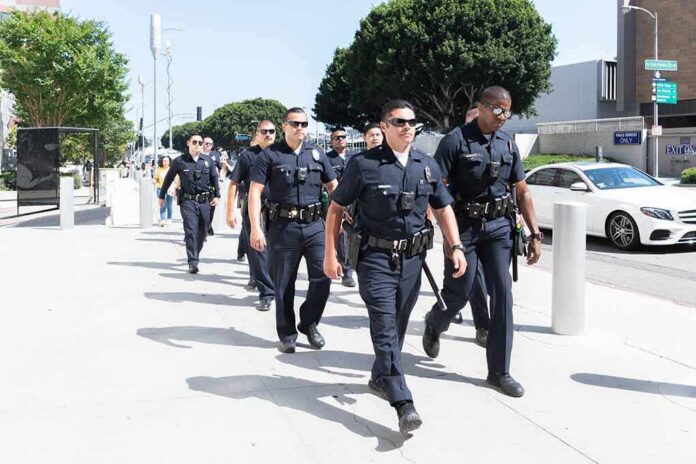
A Los Angeles mayoral candidate is pledging to replace the police chief before the 2028 Olympics, risking chaos when stability matters most.
Story Snapshot
- Nithya Raman said she wants to replace Los Angeles Police Chief Jim McDonnell, but gave no firm timeline.
- Rick Caruso warned that firing the chief could turn Los Angeles Police Department into a political experiment.
- Mayor Karen Bass cautioned a pre-Olympics shake-up could disrupt public-safety planning.
- Raman’s plan also shifts many nonviolent calls to unarmed teams, changing how 911 works citywide.
Raman’s Pledge to Replace the Chief
Nithya Raman said at the October 13 debate that she wants to replace Los Angeles Police Chief Jim McDonnell if she wins, while noting the decision involves other city bodies. She previously argued McDonnell had not met the moment and lost public trust, linking her stance to immigration-related concerns. Coverage shows she has not set a clear timetable. Reports say she declined to say whether a change would come before the 2028 Olympics, adding uncertainty for the department.
Reports also describe shifting signals about timing. One account said her remarks moved between a possible 2030 change and an earlier removal before the end of McDonnell’s term. The lack of a set schedule leaves officers, planners, and residents guessing who will lead the force through major events. Leadership clarity helps planning and morale, while confusion can slow decisions on staffing, training, and technology ahead of large-scale operations.
Olympics Security and Continuity Concerns
Mayor Karen Bass warned that replacing the chief before the 2028 Games could push the department into disarray during a demanding security build-up. Reporting identifies McDonnell’s current term as extending into late 2029, which overlaps Olympic planning milestones. Rick Caruso said he has “extreme concern” when a candidate talks about firing a police chief, and he does not want the department to become a “lab experiment” for ideological agendas. His warning speaks to continuity, not only politics.
Research on big-city policing shows faster turnover among chiefs and friction with political leaders as common stress points. High churn can strain morale, blur mission, and complicate recruitment, which many chiefs already say is hard in the current climate. That does not prove a change would harm safety in this case, but it does explain why sudden shifts near a global event raise red flags. Bass’s and Caruso’s cautions rest on those operational risks, not only campaign rhetoric.
What Raman Would Change in Policing
Raman’s platform goes beyond personnel. Her first-100-days outline calls for scaling up unarmed crisis-response teams to take many nonviolent calls, hiring more 911 operators, improving response times, and increasing patrols in commercial corridors. Her campaign plan says citywide unarmed teams would handle behavioral-health, substance-use, and homelessness-related calls so officers can focus on serious crime. She cites a city evaluation claiming the pilots provided more appropriate care and freed thousands of police hours.
Nithya Raman Calls For LAPD Chief’s Removal, Clashes With Bass
Raman called for LAPD Chief Jim McDonnell’s removal, while Bass warned against changing leadership before the 2028 Olympics.
Read More: https://t.co/GS6rLMjU5t#IndiaWest pic.twitter.com/HXg2gfnllK
— India West (@indiawestnews) October 15, 2026
Her supporters argue this model reduces unnecessary armed encounters and directs officers to crime hot spots. Her critics ask how dispatch will screen calls, how teams will handle sudden danger, and whether the shift will slow armed backup when needed. The record here does not offer conclusive proof that these changes improve or reduce safety. The available reporting documents her goals and the promise of freed officer time, but not measured crime or response-time outcomes tied to this exact plan.
Process Limits and Practical Realities
Raman acknowledged the mayor cannot remove the chief alone. The Police Commission and, in some cases, the City Council have roles in appointments, oversight, and removals, which can lengthen any transition and add procedural checks. Los Angeles Police Department rules and the City Charter shape how leadership changes actually happen, meaning any shift would require a careful, lawful process rather than a snap decision. That structure may temper the pace of any proposed change even if voters back her agenda.
Bottom Line for Public Safety
Here is what is clear: Raman wants a new chief and a reworked 911 playbook; Bass and Caruso warn that a pre-Olympics shake-up risks instability; and the timeline remains uncertain. The decisive question is operational: Will Los Angeles Police Department enter 2028 with stable leadership, clear lines of command, and tested protocols? Voters deserve specifics on timing, interim leadership, dispatch criteria, and backup rules so safety is not left to guesswork during the most watched event in decades.
Sources:
latimes.com, nypost.com, yahoo.com, dailynews.com, rmlapd.top, nbclosangeles.com, lemitonline.org, pmc.ncbi.nlm.nih.gov, law-journals-books.vlex.com