

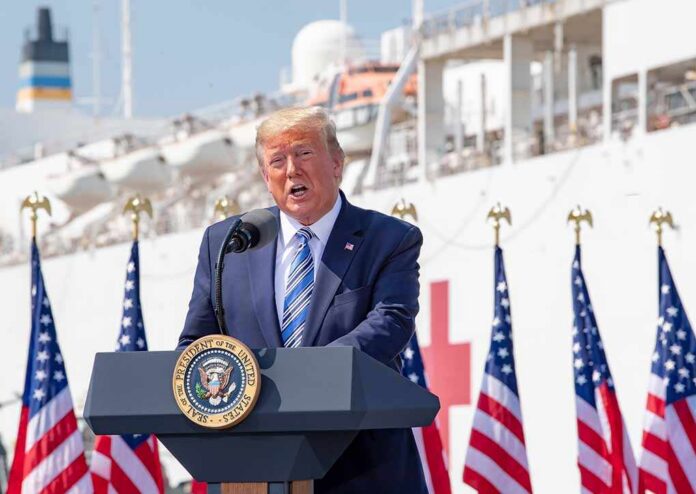
At a Georgia rally, President Trump said the United States is “making a fortune” from high oil, even as drivers face elevated gas prices.
Story Snapshot
- Trump said U.S. oil and gas are earning “hundreds of billions,” and predicted pump prices will fall soon.
- Reports put average gasoline around the mid-$4 range this month, squeezing family budgets.
- Critics seized on Trump’s “don’t give a damn” phrasing to claim he is tone-deaf to household costs.
- Energy data show crude oil drives pump prices; wars and supply shocks keep pressure high.
What Trump Said In Georgia, And Why It Matters
On October 24 in Perry, Georgia, President Trump told supporters that the United States is “making a freaking fortune” from oil after Middle East turmoil pushed prices higher. He linked the gains to drilling and shipments tied to Texas, Oklahoma, and Louisiana. He also said advisers urged caution because people are paying more but added that prices would come down. His “don’t give a damn” phrasing drew intense coverage and political pushback after the event.
Trump’s core claim rests on stronger revenue for domestic producers and oil states when crude is high. That can mean bigger royalty checks, severance taxes, and profits. But his “hundreds of billions” number was not backed by public budget data in the reports reviewed. The statements as quoted did not separate private profits from public revenues or show how these gains offset family fuel costs. That gap leaves room for critics to frame the remark as cold or unclear.
What Drivers Are Paying Right Now
Recent reports place the national average gasoline price in the mid-$4 range, well above levels before the latest conflict. One October snapshot showed $4.37 per gallon, up about 47 percent from late February’s $2.98 reference point. Diesel costs remain especially tough for trucking, farms, and construction, which pass costs into food and goods. That is why pump pain feels like a tax on everyone, not just motorists, and why voters keep talking about it in surveys.
A Brown University tracker cited by national media estimated Americans paid about $100.9 billion in extra gasoline and diesel since the war began, or roughly $770 per household. The same analysis split gasoline at about $55 billion and diesel near $46 billion in added costs. Those are big numbers for working families, small businesses, and independent truckers trying to stay afloat. These figures also explain why any messaging that minimizes pump pain draws fast backlash.
How Oil Prices Push The Pump — And What Can Change It
Energy Information Administration guidance explains that crude oil is the largest part of gasoline prices, with the rest coming from refining, distribution, marketing, and taxes. When wars and supply disruptions drive crude up, the pump follows. Refining margins also swing by season and region, making local spikes worse. That is why leaders of both parties have struggled with fuel costs since the 1970s, and why anger rises when people feel Washington cannot or will not fix it fast.
Trump’s team has argued the surge is temporary and that global supply will adjust. Some moves aim to add barrels or diesel supply, though experts question whether these steps can cut prices much in the short term. The most durable relief still comes from more stable production, more refining capacity, and fewer chokepoints abroad. That points back to a long-standing conservative view: unleash American energy, reduce red tape, and stop policies that punish drilling and refining.
The Politics: Tone, Timing, And Conservative Priorities
Democratic strategists spotlighted Trump’s “I don’t give a damn” line to claim he shrugs at family budgets. They argue the quote will show up in ads and hurt Republicans with undecided voters. But the larger policy fight remains the same: Do we embrace more American production and pipelines, or chase climate mandates that raise costs and weaken energy security? For conservatives, the answer is clear. Energy independence is not a slogan. It is a shield against foreign shocks.
🚨BREAKING: President Trump dismisses criticism over high gas prices, saying the U.S. is making record profits and that he doesn’t care about the backlash.
The "Corporation" is making record profits!
The People are struggling.
Trump is part of the "Corporation"
The SWAMP! pic.twitter.com/WDKju7lh7B— Texas Warrior Kimm Schuman (@SchumanKimm) October 25, 2026
Conservatives can take two facts at once. Producers and oil states are booking strong revenues during the spike. At the same time, families are hurting from higher gas and diesel. The path that honors both truths is to grow U.S. supply, speed permits, expand refining, and protect the grid from green mandates that fail in a crunch. That approach defends paychecks, restrains inflation, and keeps America strong when the world gets dangerous.
Sources:
yahoo.com, vinnews.com, thehill.com, nbcnews.com, cnn.com, finance.yahoo.com