
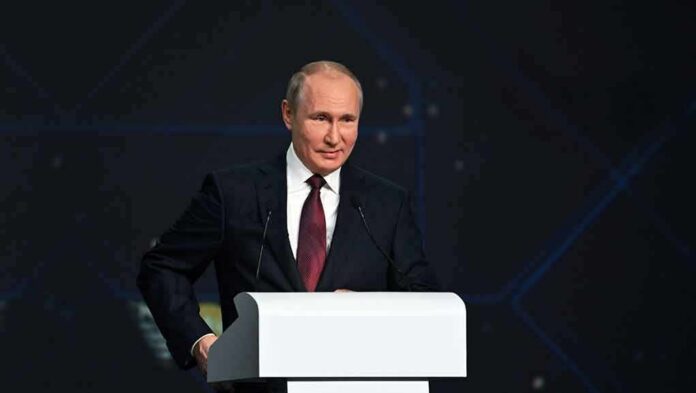
The Kremlin says President Trump, President Putin, and President Xi could meet together in November, setting up a rare showdown of the world’s top powers at the Asia-Pacific summit.
Story Snapshot
- Kremlin officials said a three-way Trump–Putin–Xi meeting is on the table at the November Asia-Pacific summit.
- The idea surfaced after talks between Vladimir Putin and Xi Jinping; Moscow says it depends on attendance and host plans.
- Such a session would be unprecedented and would signal high-stakes power diplomacy at the summit.
- Reporting ties the potential meeting to the Shenzhen gathering on November 18–19, if schedules align.
Kremlin Confirms Trilateral Talks Are Under Consideration
Russian aide Yuri Ushakov said Russia and China discussed a possible three-way meeting with President Trump at the Asia-Pacific Economic Cooperation summit in November. Ushakov stated the topic “was discussed” and that a session could occur if all three leaders attend and the host country organizes it. Russia’s Deputy Foreign Minister Sergei Ryabkov later said Moscow has not ruled out the plan. His remarks kept the door open while stressing conditions still apply. This is the clearest on-record signal from Moscow so far.
Bloomberg noted that a first-of-its-kind meeting among the three nuclear powers would be unprecedented. The outlet highlighted how the Kremlin cast the idea as tied to the Asia-Pacific Economic Cooperation sidelines. That venue often enables side talks more than big multilateral deals, which makes a possible three-way sit-down notable for its symbolism and timing. Additional regional outlets and wires repeated the core facts: the Kremlin floated it, and logistics will decide it.
APEC Setting Points To High-Impact Sidelines Diplomacy
Asia-Pacific Economic Cooperation summits often serve as staging grounds for pivotal side meetings. Analysts and past coverage show leaders use the margins to talk trade, security, and crisis issues when formal sessions move slowly. The fact of contact can matter as much as signed text. That pattern fits this case: Moscow’s comments emphasize “if” conditions, attendance, and host planning before any final green light. This structure signals real interest but leaves room for flexibility as travel plans harden.
Reports also place this year’s gathering in Shenzhen on November 18–19, aligning with Russia’s framing of a late-year window for a potential sit-down. The calendar focus is key. Leaders need tight coordination to stage even a brief pull-aside. The Kremlin’s public float can help shape schedules and expectations. It also spotlights Russia’s aim to appear central in great-power talks. For Washington, smart use of the forum can advance American interests with clear goals, firm red lines, and practical deliverables.
What A Three-Way Meeting Could Mean For U.S. Interests
A Trump–Putin–Xi meeting could give the United States a direct channel to press core priorities. Energy stability, fair trade, supply chains, and stopping illicit fentanyl flows all tie to American jobs, prices, and safety. Past Asia-Pacific summits produced symbolic but useful steps on air links, military talks, and technology pathways, showing that contact can reduce risk and open doors for follow-up work. A trilateral format could compress messages, cut mixed signals, and test areas for limited, concrete progress.
For conservative readers, the stakes are clear. Strong borders, a healthy economy, and peace through strength depend on clear-eyed talks that serve Americans first. A disciplined meeting could push back on globalist drift by setting terms that protect U.S. workers and industry. It could also press China on unfair practices and press Russia on strategic stability and energy impacts. The Asia-Pacific stage allows President Trump to speak plainly, demand results, and reject any agenda that weakens American sovereignty.
Managing Risks While Seizing Strategic Openings
Great-power meetings carry risks if used for show over substance. Careful preparation, a tight agenda, and measured expectations keep focus on outcomes that matter at home. The Kremlin’s public float underscores how narrative management can get ahead of final plans. The White House can counter that by setting the terms, defining measurable goals, and ensuring any photo-op follows real work. That approach respects taxpayers, defends the Constitution, and keeps government in its proper lane.
Trump and Putin also discussed possibly holding a trilateral summit– with Chinese leader Xi Jinping — during the APEC summit in November, per Kremlin spokesman Dmitry Peskov. (Notable that the White House has still not released any read-out of the call).https://t.co/gLsr5QmUfq https://t.co/fucuGLzkFx
— Mike Eckel (@Mike_Eckel) September 9, 2026
If the leaders meet, the United States should aim for clear wins that families can feel. Lower energy costs through stable markets. Safer streets through action on drug precursors. Fairer trade that lifts paychecks, not party talking points. These are practical tests, not talking games. The Asia-Pacific summit is a tool, not a trophy. Used well, it can help secure peace through strength without giving ground on American values or freedom.
Sources:
insiderpaper.com, reuters.com, iz.ru, newscord.org, koreatimes.co.kr