
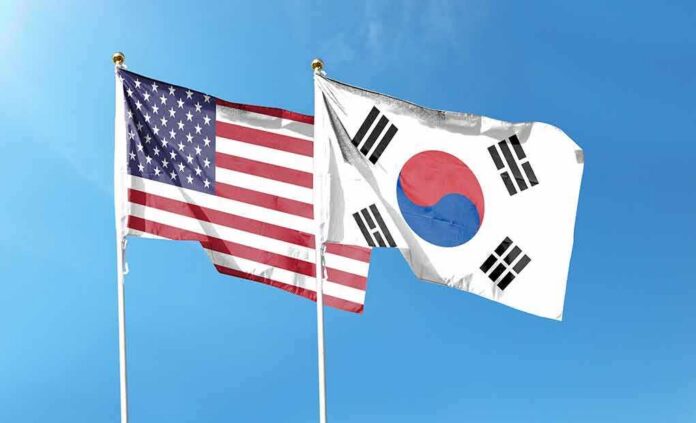
President Trump moved to slash major U.S.–South Korea war games after Seoul refused to back his push against Iran, tying alliance privileges to real burden-sharing.
Story Highlights
- Trump ordered a substantial cut to joint drills with South Korea and linked it to Seoul’s Iran stance.
- The president called the exercises costly and the signal “inappropriate” under current conditions.
- The Ulchi Freedom Shield drills were large, scheduled, and central to alliance readiness.
- Analysts claim the pressure could strain the alliance, but the tool is a known U.S. leverage method.
Trump Links Drill Cuts To Iran Cooperation
President Trump said he told the Pentagon to “substantially reduce” joint military exercises with South Korea. He tied the move to Seoul’s refusal to join United States actions aimed at denuclearizing Iran. He wrote that he asked South Korea’s president to take part and said the reply was, “No thanks!” His post also argued the drills are costly and send the wrong signal at this time. Reuters reported the directive and the Iran linkage from Trump’s own words.
Trump’s message reflects a clear standard: allies who want American protection must share the load when it counts. He framed the exercises as an expense that does not fit the moment and as a signal that could be read as hostile. He also pointed to recent respect and restraint from adversaries under his watch, which, in his view, makes massive maneuvers less fitting right now. The president’s public post became the anchor for understanding the shift.
What The Drills Mean And Why A Cut Matters
The Ulchi Freedom Shield exercises were set for August 17–27 and were designed to test combined readiness against drones, satellite navigation disruption, and cyberattacks. They included about 18,000 South Korean personnel and a complex scenario package. These drills are not symbolic parades. They are central to how both sides practice to “fight tonight” if North Korea acts. They have long served as a top-tier tool to signal credible deterrence to Pyongyang.
Congressional research has long described combined and joint training as the heart of the alliance. It helps keep American and South Korean forces ready, integrated, and able to respond fast. Freedom Shield is among those core events. Adjusting that activity is a real lever. It is not a press release or a scolding speech. It changes planning cycles, playbooks, and political messages. That is why it draws strong reactions from both supporters and critics.
Burden-Sharing Leverage Versus Alliance Friction
Trump’s move uses a familiar tool in alliance politics: condition access and protection on shared effort. Supporters call this common sense. They argue it forces partners to step up and stop taking U.S. power for granted. Academic work on alliance burden-sharing calls this “conditional pressure.” It is a way to encourage action without walking away from commitments. Done right, it can nudge allies to contribute more where the United States needs it most.
Critics warn that tying Korea drills to Iran policy adds strain. They say it risks confusing the mission on the peninsula and could embolden North Korea. Reuters and others featured analysts who said Trump’s style unsettles allies and frays ties that help keep peace. They argue this approach weakens the so-called rules-based order and could outlast a given crisis, leaving scars in key partnerships. That concern shaped much of the early media reaction.
Facts, Limits, And What We Still Do Not Know
The public record centers on Trump’s social media post, not a full Pentagon directive published for review. The reporting does not present a South Korean readout confirming the quoted “No thanks!” reply. It also does not cite a treaty that obliges Seoul to back United States actions on Iran. Those gaps do not erase the president’s authority to set exercise policy, but they do mark the limits of what is confirmed in documents today.
🚨 Trump just ordered a major cut to joint military exercises with South Korea.
His words:
“Based on my very good relationship with Kim Jong Un… these exercises are not only costly… but send a signal that is totally inappropriate and hostile to a Country that… has been…
— Louis Montoya (@montoyalouis1) August 17, 2026
Reuters also detailed that the drills were designed to deter North Korean threats, including missiles and cyber risks. That makes the linkage to Iran unusual in the open record. The United States has used training changes as leverage before, but usually tied to the same theater. Here, the message crosses regions. That is a sharper form of pressure. It says alliance benefits depend on standing with America when America sets a priority, even if it is not your backyard fight.
What This Means For U.S. Strength And Values
American taxpayers are tired of footing every bill while elites overseas hedge. Trump’s action tells allies that free rides are over. It respects the Constitution’s charge to defend the nation by using the tools of policy, not endless war. It protects our troops by demanding others do their share before we put more on the line. It also keeps the door open: step up on core missions, and the United States will be there with full strength. That is tough, fair leadership grounded in accountability.
Sources:
theatlantic.com, cnbc.com, reuters.com