

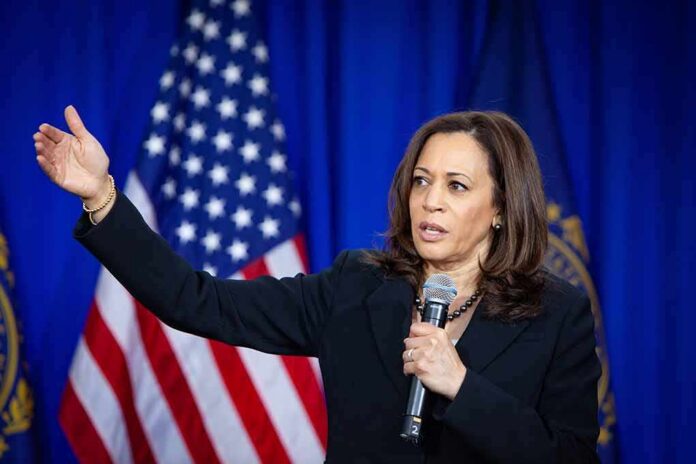
Vice President Kamala Harris is campaigning in Michigan with Abdul El-Sayed to boost turnout and help Democrats retake the Senate, using a roundtable on Black maternal health as the draw.
Story Highlights
- Harris confirmed a Michigan stop with El-Sayed to drive turnout and target Senate control.
- El-Sayed’s team said the event centers on Black maternal health and health care costs.
- The campaign billed it as a policy roundtable, not a rally, in a key battleground.
- Harris endorsed El-Sayed after his primary win, tying the push to prices and control of the Senate.
Democrats Deploy Harris in Michigan to Lift Senate Prospects
Harris’s spokesperson said she will return to Michigan to help “turn out the vote” and flip the Senate, directly linking the visit to lowering prices and standing up to President Trump’s agenda, which Democrats label as “corruption”. El-Sayed’s campaign welcomed the vice president and framed the visit as focused on Black maternal health and lowering health care costs. The stop fits the playbook for battleground states where high-profile surrogates aim to spark base turnout before Election Day.
Multiple outlets described the appearance as a scheduled roundtable on maternal and infant mortality disparities in the Black community, not a standard stump rally. El-Sayed told one outlet he looked forward to Harris’s visit and called her an inspirational figure in communities like Detroit. Campaigns often choose these policy-heavy formats to show issue alignment, court local leaders, and earn coverage that extends beyond a single news cycle.
Why Democrats Chose Maternal Health as the Message Frame
Reports tied the roundtable to Harris’s ongoing focus on maternal health, which El-Sayed also highlighted as a shared priority. The topic gives Democrats a human-interest lens while they argue they can cut costs for families. Harris’s endorsement statement stressed rising costs for housing, gas, groceries, health care, and child care, while accusing Republicans of favoring the wealthy with tax breaks, a contrast she wants on the ballot alongside Senate control. That pairing links pocketbook talk with a targeted community issue.
Campaign research shows surrogate visits can move vote share at the margins when the messenger, audience, and message align, which is why campaigns invest time in these stops. Michigan is again described as a key battleground where small shifts matter, making a vice-presidential visit a logical use of limited days. The scheduling clarity—date, format, and focus—reduces ambiguity about the purpose: mobilize voters who care about maternal health and lean Democratic in statewide races.
Endorsement Ties the Event to Senate Control and Costs
Harris endorsed El-Sayed following his August primary victory and said she “proudly” stands with him to win a Democratic Senate majority, reinforcing that the Michigan stop is part of a broader map fight, not a one-off favor. Her statement argued Democrats are the party pressing to ease daily costs while Republicans protect the powerful, a contrast Democrats will repeat in ads and surrogates’ remarks through November. The event’s design supports that message with a health care focus.
Former Vice President Kamala Harris made her first midterm campaign stop of the current election cycle Tuesday in Detroit, joining Democratic Michigan Senate candidate Abdul El-Sayed at a roundtable focused on Black maternal health care.https://t.co/PN8gZytMQd
— CBS Austin (@cbsaustin) September 23, 2026
El-Sayed’s team framed Harris as a turnout amplifier respected in Detroit, making the stop useful for media reach and local validation. The campaigns did not release detailed attendance data or post-event transcripts in the provided materials, so the record is strongest on the who, what, where, and why of the scheduled roundtable, rather than on measurable turnout impact. Still, the documented statements and endorsements anchor the visit within Democrats’ Senate strategy and cost-of-living pitch.
Sources:
insiderpaper.com, abcnews.com, thehill.com, detroitnews.com, foxnews.com, washingtontimes.com, abdulforsenate.com