
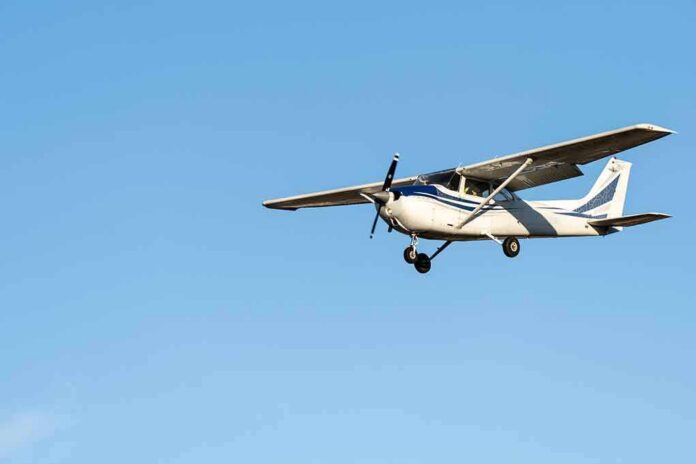
One airplane and one six‑pack of beer have become the test case for how far a government can go in using criminal forfeiture as punishment—particularly when the value of the property dwarfs the underlying offense.
Key Points
- Alaska pilot Kenneth Jouppi faces mandatory forfeiture of his $95,000 Cessna after a passenger brought beer on a flight bound for a “dry” village where alcohol is banned.
- Alaska courts upheld the forfeiture under state law and ruled it is not an unconstitutionally excessive fine under the Eighth Amendment.
- The statute treats aircraft as uniquely subject to automatic forfeiture when used to import alcohol into local‑option communities, regardless of quantity or prior record.
- The U.S. Supreme Court has now agreed to hear Jouppi’s challenge, potentially reshaping the national law of criminal forfeiture and excessive fines.
The Case: A Bush Pilot, a Dry Village, and a Six‑Pack of Beer
In 2012, Fairbanks bush pilot Kenneth Jouppi was preparing to fly from Fairbanks to Beaver, a remote Alaska village that had chosen, under state “local‑option” laws, to ban the importation and possession of alcoholic beverages. Alaska State Troopers discovered beer in a passenger’s luggage for the flight—reporting from different outlets variously describes a six‑pack and three cases, but the Alaska Supreme Court’s analysis ultimately focused on “even a six-pack of beer.”
Beaver’s dry status made the attempted importation a crime. Under Alaska Statute § 04.11.499(a), it is unlawful to knowingly send, transport, or bring alcoholic beverages into a local‑option community. After a jury trial, Jouppi was convicted of unlawful importation, a Class A misdemeanor punishable by up to a short jail term and a relatively modest fine. At sentencing, he received traditional criminal penalties. But a second, far more consequential sanction loomed: the state sought forfeiture of his 1969 Cessna U206D, valued around $95,000, because it had been used to facilitate the offense.
That forfeiture was not a discretionary add‑on. Alaska’s criminal forfeiture scheme makes aircraft “always subject to mandatory forfeiture” when used to transport alcohol into a local‑option community, regardless of whether the conviction is a misdemeanor or felony and regardless of whether it is a first offense. Cars, boats, and other vehicles are typically treated more leniently, with forfeiture tied to repeat offenses or larger quantities. Aircraft sit in a different legal category.
Alaska’s Forfeiture Law and Why Aircraft Are Treated Differently
To understand why Alaska is willing to take an entire aircraft over beer in a passenger’s groceries, you have to understand its geography and its politics about alcohol. Dozens of Alaska communities have, over time, voted themselves “dry” or “damp” under state statute, effectively banning possession or importation of alcohol within their borders. Many of these villages are roadless; for much of rural Alaska, planes are the only practical way to move people and goods.
Alcohol abuse in remote Alaska is not viewed by lawmakers as a marginal social problem. In the legislative record cited by the Alaska Supreme Court, lawmakers emphasized alcohol’s links to crime, domestic violence, fetal alcohol spectrum disorders, and death, and the strain those harms place on thin public health and law enforcement resources. Within that context, the legislature decided to target the means of transport itself. Under AS 04.16.220, using a plane to transport alcohol into a dry village subjects the aircraft to forfeiture automatically—“no matter the quantity and no matter the seriousness of the offense,” as Jouppi’s petition to the U.S. Supreme Court later summarized.
The Alaska Court of Appeals and then the Alaska Supreme Court interpreted this statutory scheme broadly. The Court of Appeals held that forfeiture is required “regardless of whether the transportation of the alcoholic beverages is actually completed”; in other words, preparation to take off with alcohol bound for a dry village is enough. The Alaska Supreme Court agreed that the statutory trigger had been met and focused its constitutional analysis on whether taking the plane violated the Eighth Amendment’s Excessive Fines Clause.
What Alaska’s Supreme Court Decided
The Excessive Fines Clause, incorporated against the states in 2019’s Timbs v. Indiana decision, requires that monetary penalties and forfeitures not be “grossly disproportional” to the gravity of the offense. In Jouppi v. State, Alaska’s highest court unanimously held that forfeiting the plane was punitive and therefore subject to the Excessive Fines Clause—but that, as a matter of law, the forfeiture was not unconstitutionally excessive.
Justice Jude Pate’s opinion framed the gravity of the offense not in terms of Jouppi’s individual conduct or the street value of the beer, but in terms of the broader social harms of alcohol in rural Alaska. The court wrote that “illegal importation of even a six-pack of beer causes grave societal harm,” given the background of violence, health consequences, and limited state capacity in remote villages. That harm, the court reasoned, strongly suggested that forfeiture of the airplane was not grossly disproportionate.
Crucially, the Alaska Supreme Court rejected the idea that courts must weigh individual facts, such as whether the offense was part of a larger pattern of criminal behavior, in every forfeiture case. It deemed it “not particularly relevant” whether Jouppi’s conduct fit a pattern and held that no further factfinding was needed; the legislature’s judgment and the statutory scheme were sufficient to uphold forfeiture.
Earlier in the litigation, a trial court had found the forfeiture excessive, noting that the plane’s value was roughly nine and a half times the maximum fine authorized for the misdemeanor. The Alaska Court of Appeals and later Supreme Court reversed that view, privileging legislative intent and societal harm over a simple ratio of property value to statutory fine.
The Constitutional Challenge: Excessive Fines and Proportionality
Jouppi, now in his eighties, has not accepted the loss of his plane quietly. Represented by the Institute for Justice and other counsel, he argues that Alaska’s approach conflicts with the U.S. Supreme Court’s modern Excessive Fines jurisprudence, particularly United States v. Bajakajian and Timbs v. Indiana.
In Bajakajian, the Court held that forfeiting the entirety of undeclared currency a defendant attempted to take out of the country was an excessive fine, emphasizing a fact‑intensive analysis that considered, among other things, the seriousness of the offense, the harm caused, and other authorized penalties. Jouppi’s petition argues that Alaska’s “as a matter of law” approach discards this individualized proportionality test in favor of abstract harms—alcohol’s effect on rural Alaska writ large—effectively “saddling Jouppi with the evils of alcohol abuse writ large.”
His legal team also stresses the disparity between the value of the plane and the underlying offense. The criminal conduct was a first‑time misdemeanor involving a small quantity of beer, yet the forfeiture reaches a six‑figure asset central to his livelihood. They argue that, under Bajakajian and Timbs, that kind of mismatch should at least require careful factfinding, not categorical approval.
More broadly, civil liberties advocates point to Jouppi’s case as emblematic of how forfeiture can become a tool of overpunishment, especially when statutes define property used in an offense as automatically forfeitable without judicial discretion. Aircraft forfeiture in Alaska is harsher than for cars or boats, and critics see that as a sign of a deterrence strategy that has outrun proportionality.
Why the U.S. Supreme Court Took the Case
The U.S. Supreme Court has now agreed to hear Jouppi v. Alaska, setting the stage for a significant decision on excessive fines and criminal forfeiture. The Court is not being asked to decide whether Alaska may ever seize a plane in an alcohol case; it is being asked how courts must evaluate whether such a forfeiture is excessive.
Alaska, in its briefs, defends its statute and the forfeiture. The state emphasizes that aircraft are often the only practical means to smuggle alcohol into dry villages, that alcohol abuse has “wreaked havoc” in rural Alaska, and that the legislature intentionally chose strict measures to deter bootlegging. From that perspective, forfeiting a plane used for bootlegging is a rational, legislative judgment, not an extreme outlier.
The petitioners, by contrast, argue that Alaska’s approach abandons the requirement that punishment be tied to the specific offense and offender. They ask the Court to reaffirm that the Excessive Fines Clause demands more than a generalized appeal to social harm, and to clarify that mandatory forfeiture schemes cannot bypass individualized proportionality review.
The case arrives at a moment when the Supreme Court has shown increased interest in fines, fees, and forfeitures as constitutional issues. Timbs underscored that states are fully bound by the Excessive Fines Clause; subsequent lower‑court decisions have wrestled with applying Bajakajian’s framework to property with high monetary value but modest underlying offenses. Jouppi’s airplane, seized over beer bound for a dry village, now becomes a concrete vehicle for resolving those tensions.
Beyond One Plane: Forfeiture, Deterrence, and Rural Governance
Whatever the Supreme Court decides, the case illustrates a broader pattern in forfeiture law. Governments often target valuable, mobile assets—cars, boats, cash, and here aircraft—as “instrumentalities” of socially disfavored offenses. In Alaska, alcohol in dry villages is one such offense; elsewhere, it may be drug trafficking, illegal gambling, or customs violations.
When forfeiture is tied to use of the asset rather than the scale of harm, disputes like Jouppi’s are almost inevitable. A single trip can trigger loss of an asset worth many times any authorized fine. Legislatures may see that as necessary deterrence, especially in environments where enforcement is difficult. Property‑rights advocates see it as an invitation to disproportionate punishment and, in some jurisdictions, a revenue stream for law enforcement agencies.
In rural Alaska, where planes are lifelines, the stakes are particularly high. For pilots and air carriers serving local‑option communities, the law sends an unmistakable message: any involvement in alcohol importation, even with passengers’ cargo, carries catastrophic risk. That may deter some bootlegging. It may also chill legitimate service or encourage hyper‑cautious behavior that has its own costs.
Jouppi’s case will not settle every debate about forfeiture. But by forcing the Supreme Court to confront a stark example—a $95,000 plane forfeited over a six‑pack—it will help define how American law balances legislative judgment, social harm, and constitutional limits on punishment. The answer will matter not only in Alaska’s bush communities but wherever governments use property seizure as a central tool of criminal policy.
The Supreme Court agreed Monday to hear the case of an Alaska bush pilot claiming authorities violated his Eighth Amendment rights after they tried to seize his airplane over beer. In 2012, pilot Kenneth Jouppi was attempting to take a passenger to a remote village called Beaver,…
— Common Sense with Chad Law (@chadparkerlaw) July 21, 2026
What to Watch as the Case Moves Forward
For readers trying to make sense of the eventual decision, several questions will be key. First, does the Court reaffirm or reshape Bajakajian’s “gross disproportionality” test, and does it insist on individualized factfinding? Second, does it address mandatory forfeiture schemes specifically—those that leave judges little discretion once statutory triggers are met? Third, how much deference does it grant to legislative assessments of social harm when those harms are broad and long‑term rather than tied to the particular offense?
If the Court sides with Alaska, states will have a freer hand to design strict forfeiture regimes around perceived social crises, with courts deferring to legislative judgments about harm. If it sides with Jouppi, expect renewed scrutiny of high‑value forfeitures nationwide and a wave of challenges to statutes that treat property as automatically forfeitable without proportionality review.
Sources:
nypost.com, theepochtimes.com, caselaw.findlaw.com, alr.law.duke.edu, jonathanturley.org, alaskapublic.org, law.justia.com, finesandfeesjusticecenter.org, supremecourt.gov, washingtonexaminer.com, washingtontimes.com, cato.org, news.bloomberglaw.com, findlaw.com