
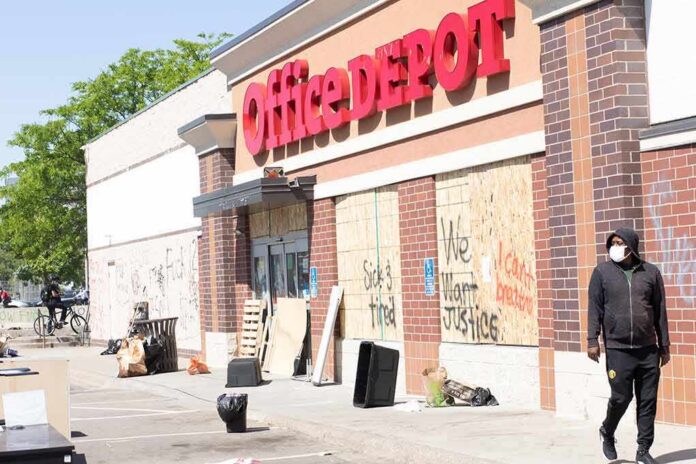
Paris storefronts on the famed shopping corridor are boarded up as French authorities flood the streets ahead of another volatile protest weekend.
Story Highlights
- Shops near recent flashpoints in Paris secured windows and doors with boards before protests.
- Authorities mobilized tens of thousands of officers and riot gear after prior riots.
- Police cleared crowds from key Paris squares during security operations.
- Earlier unrest saw cars torched, stores looted, and hundreds arrested across France.
Shops Board Up Near Recent Hotspots
BBC live coverage documented stores around Place de la République boarding their windows as Paris braced for new protests. Reporters identified the area as a focus of recent clashes. Business owners faced a hard choice. They could close and try to protect property. Or they could stay open to make rent and keep staff working. The boards signaled fear of repeat damage. They also showed how past chaos now shapes routine business planning in the city.
Shops did not receive a citywide order to close. Evidence in reports pointed to targeted steps in districts hit before. The volume of boarded storefronts across Paris was not clear. No outlet provided a full count or list. That gap matters to scale, not to the core fact. Businesses in key areas took visible steps to shield windows and doors. This lined up with warnings from authorities and with the memory of broken glass and looting last time.
Massive Security Deployment After Riots
Reuters reported that Interior Minister Gérald Darmanin deployed 45,000 police officers after three nights of riots in 2023 and called the coming hours decisive. The Associated Press later reported authorities planned to deploy about 70,000 officers ahead of a new protest weekend, while closing major cultural sites for safety. These figures came from different dates and operations, but they mark the scale France now uses when unrest flares. The message was simple: saturate streets to deter violence.
Authorities paired manpower with tools. Reports described helicopters, armored vehicles, water cannons, and elite units on standby to protect buildings and disperse violent groups. Officials also leaned on a familiar tactic. Soldiers from Operation Sentinelle would guard static sites, freeing police and gendarmes for crowd control. Euronews cited this as the reason for using military personnel in support roles, not as front-line riot cops. That kept trained officers mobile where protests could turn.
Police Move Quickly To Control Key Squares
Police actions focused on central symbols. Reuters reported that officers cleared protesters from Place de la Concorde after an impromptu gathering. Clearing central squares matters for two reasons. First, it keeps crowds away from national monuments and government buildings. Second, it breaks up groups before late-night flashpoints start. The tactic reflects years of lessons from the Yellow Vests and from riots tied to police incidents.
CBS News described the earlier unrest in stark numbers. Reporters cited torched cars, ransacked shops, hundreds of arrests, and roughly 40,000 police and gendarmes deployed nationwide during the peak of that crisis. Those hard facts explain why shopkeepers now use boards and why the state sends so many officers. When violence costs jobs and savings, people adapt. When public order breaks, governments respond with force. Paris is living both sides of that cycle.
Balancing Security And The Right To Assemble
French law protects the right to demonstrate, but authorities can restrict events when they judge a real risk to public order. That tension shows up each protest weekend. News outlets reported bans, route changes, and rapid clearances. Critics often claim overreach. Supporters point to burned cars and broken stores. An Associated Press report noted that museums closed on a recent Saturday for safety, a sign that the government weighed risks and chose caution for public spaces.
France 🇫🇷 is bracing for the second round of protests. French authorities deployed 70,000 police and gendarmes countrywide, including elite units like BRI, RAID, and GIGN plus armored vehicles, amid route disputes in Paris and fears of renewed unrest.
Initially, the media…
— TheLogicalOne 🇺🇸 (@Logicalone) October 24, 2026
The neutral legal backdrop helps explain the scene. Demonstrations are typically declared in advance, and limits are supposed to be case-specific. But police also act on intelligence about planned unrest. That leads to preventive steps like barricades, transport changes, and guarding landmarks. When boards go up on a famous shopping street, it is not theater. It is a learned response to real damage seen before, and to a security playbook built for fast-moving crowds.
What It Means For American Travelers And Businesses
American travelers should expect closures, rerouted streets, and heavy police around central Paris squares. Crowds can shift quickly, and small groups can spark wider clashes. Businesses face a squeeze. Staying open risks damage. Closing means lost income in a tight economy. The French state is signaling zero tolerance for another wave of looting. The boards on shop windows show that store owners are not betting their livelihoods on good luck this time.
Sources:
facebook.com, bbc.co.uk, euronews.com, cbsnews.com