

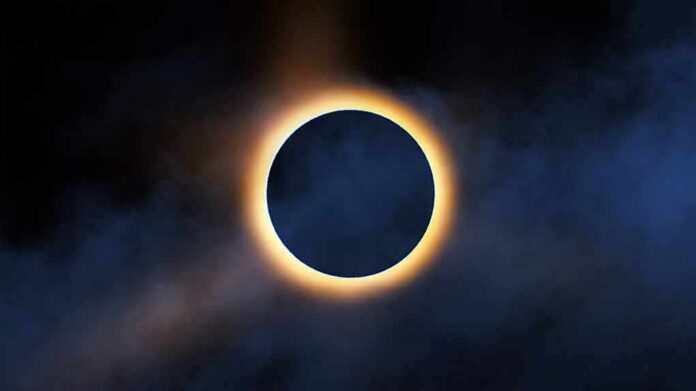
A total solar eclipse turned day into night over the North Atlantic on August 12, plunging Greenland, Iceland and northern Spain into darkness while a partial eclipse dimmed skies across a huge stretch of Europe, Canada and the United States.
Story Snapshot
- The total eclipse’s path of totality crossed Greenland, Iceland, northern Spain and a sliver of Portugal on August 12, 2026.
- A partial eclipse was visible across a much wider zone, including 26 U.S. states and Washington, D.C.
- Some spots in the United Kingdom saw more than 90 percent of the sun blocked, the biggest coverage there in about three decades.
- NASA tracked the event on its official eclipse calendar, confirming the eclipse type, timing and region of visibility.
- Skywatchers around the world are already turning attention to the next total eclipse, set for 2027 over Africa and the Middle East.
A Narrow Band Of Total Darkness
The moon’s shadow raced across the globe on Wednesday, August 12, 2026, tracing a narrow path that started over Russia’s remote Taymyr Peninsula and swept across the Arctic. From there it crossed Greenland, Iceland and a small part of northwestern Portugal before ending near northern Spain and the Balearic Islands. Only people standing inside that thin corridor saw the sun fully blocked by the moon.
Inside that path, observers briefly saw the sun’s outer atmosphere, called the corona, glow around the blacked-out disk of the moon. That moment of totality lasted only a few minutes before the sun’s light returned. Spain recorded its first total solar eclipse in more than three decades, drawing crowds who traveled specifically to stand in the shadow.
Millions More Saw A Partial Show
Far beyond the narrow path of totality, a much larger share of the Northern Hemisphere caught a partial eclipse. Skywatchers across the United States, Canada and Europe watched the moon take a visible bite out of the sun, even though it never fully disappeared for them. In the United Kingdom, more than 90 percent of the sun was covered at the peak, the most dramatic showing there in about 30 years.
In the United States, 26 states and Washington, D.C., were able to see the partial eclipse, according to mapping based on data from Time and Date. States from Maine to Minnesota to Alaska got a look at the moon’s shadow crossing the sun, even without the full blackout experienced overseas.
Why Officials Track Every Eclipse So Closely
The National Weather Service and NASA both keep detailed public records of every solar and lunar eclipse, listing the exact date, eclipse type, how much of the sun gets blocked and where the shadow falls. That kind of precise government tracking lets families, schools and travelers plan safe viewing well ahead of time instead of relying on guesswork.
This kind of careful federal science work is worth noticing. While plenty of government agencies get criticized for waste or overreach, NASA’s eclipse forecasting represents exactly the kind of practical, results-driven mission taxpayers can respect: precise, useful and free of political spin.
Eye Safety Still Matters Most
Skywatchers outside the path of totality never saw the sun fully covered, meaning direct sunlight remained dangerous to view without protection the entire time. Experts have long warned that only certified eclipse glasses, meeting the ISO 12312-2 safety standard, protect eyes during any partial phase. Regular sunglasses do not offer enough protection, no matter how dark they look.
Day briefly turned to night in Spain on Wednesday, as the country witnessed its first total solar eclipse in more than a century, plunging it into eerie darkness in one of nature’s greatest spectacles.
The spectral glow of the Sun’s outer corona, shimmering out of the edges of… pic.twitter.com/5n5ZKcnwN1
— Malay Mail (@malaymail) August 13, 2026
Families who watched together, whether through certified glasses or projected images from a pinhole camera, took part in a shared experience tying back to simple, timeless things: looking up, marveling at the natural world and teaching kids real science instead of ideology. That is a tradition worth keeping alive for the next eclipse chasers already eyeing 2027.
Sources:
space.com, nationalgeographic.com, dailysabah.com, ibtimes.com.au, gulfnews.com, forbes.com, eclipse.gsfc.nasa.gov, nationaleclipse.com