
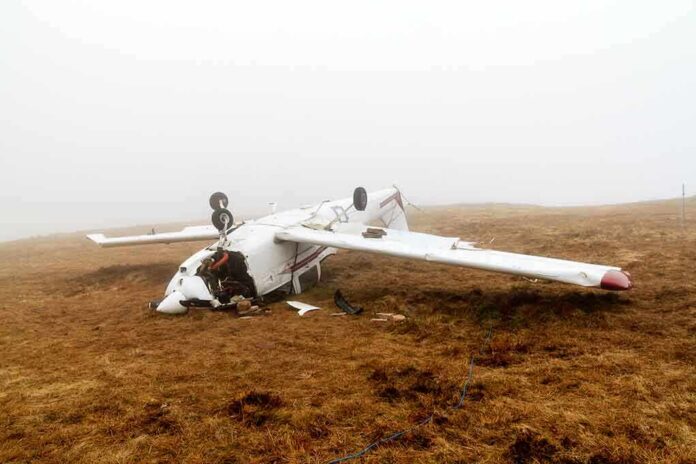
A North Carolina pilot, his wife, and their two dogs walked away after a night engine failure forced their Piper to settle into the treetops instead of the ground.
Story Highlights
- A husband, wife, and two dogs survived a forced landing after losing engine power at night.
- The Federal Aviation Administration confirmed the aircraft had mechanical trouble before hitting trees.
- The pilot reported pulling up at the last moment to let the aircraft’s belly absorb the impact.
- Investigators are reviewing the cause; reports so far do not identify a failed part.
Pilot Reports Sudden Power Loss On Night Flight
Dustin Davis told reporters his single-engine Piper PA-32 lost thrust while flying at roughly six thousand to sixty-five hundred feet over Columbus County on October 7. He and his wife, Autumn, began emergency checks and contacted air traffic control as the propeller turned but did not make power. With darkness limiting options, Davis aimed for open terrain but saw trees ahead as altitude bled away, and prepared for a controlled, low-speed impact to save everyone aboard.
Local outlets reported both occupants and their two dogs got out on their own with minor injuries. Images and witness accounts described the aircraft held above the ground by trees, with the nose near the dirt and the cabin largely intact. The scene matched a treetop “catch” rather than a direct ground strike, which often causes deadly deceleration. The couple credited faith, training, and teamwork in the cockpit as they worked the checklist and stayed calm under pressure.
Federal Aviation Administration Confirms Pre-Impact Trouble
The Federal Aviation Administration verified the plane had mechanical trouble before contacting trees. Coverage described a flexible tree that bent and left the fuselage resting several feet above ground level. That outcome reduced the crash energy and kept the cabin survivable. While reports vary on exact altitude and which tree stopped the aircraft, all agree on a power loss, a forced landing, and a walk-away result for the couple and both dogs.
Davis said he pulled back right before reaching the trees to slow and level the aircraft. Separate reporting said that maneuver let the belly take the hit rather than the wings or nose, which can rip open the cabin and raise the risk of fire. That technique aligns with general emergency landing guidance, which stresses keeping control, lowering speed, and using structure and terrain to spread out impact forces during a forced landing.
Why This Survival Matches General Aviation Safety Patterns
General aviation safety material explains that engine problems can lead to forced landings where control and energy management decide survival. Training guides stress flying the aircraft first, holding best glide, picking a landing area, and arriving under control. They also warn that night landings off-airport are risky because terrain is hard to see. Even then, pilots improve outcomes by leveling, slowing, and letting strong structures absorb the hit, which is what Davis described doing.
Federal Aviation Administration handbooks and safety briefs also note that many fatal accidents follow loss of control, not the initial power loss itself. In short, staying wings-level and avoiding a stall often separates a bad night from a tragic one. The Columbus County case follows that rule. The couple worked the problem, kept control, accepted a firm arrival, and lived. That is the hard truth of many saves in small airplanes when the engine quits after dark.
What Investigators Are Still Examining
Reporters said the Federal Aviation Administration and the National Transportation Safety Board are reviewing the cause. The stories to date do not name a failed part, a fuel issue, or a maintenance error. That detail will come later when investigators release findings. For now, established facts cover the power loss, the tree-top touchdown, and minor injuries. The rest will be sorted by the official process that follows every general aviation accident.
For readers who care about practical safety, this event offers a clear lesson. Emergencies reward discipline, not luck. Davis and his wife stayed on task, talked to controllers, aimed for survivability, and made the airframe take the hit. That mindset reflects the best of personal responsibility and training. It also shows why strong families, faith, and preparedness matter when seconds count and help is still miles away in the dark Carolina woods.
Sources:
nypost.com, wsoctv.com, wwaytv3.com, foxsanantonio.com, aopa.org, us.headtopics.com