
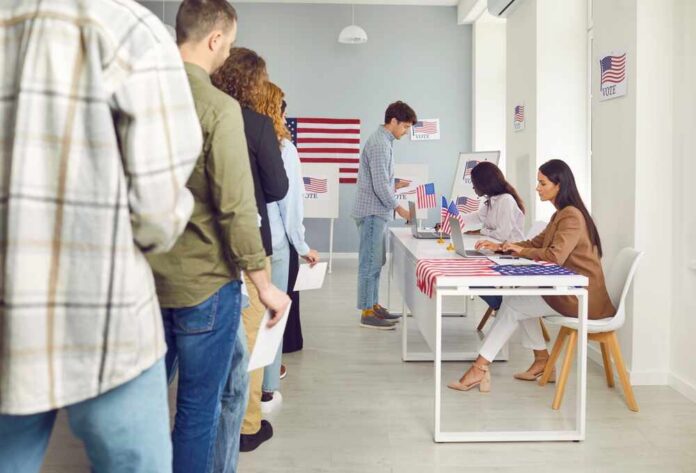
The Trump Department of Justice is warning state officials they could face criminal charges if they let non‑citizens vote in federal elections.
Story Snapshot
- Federal law makes it a crime for non‑citizens to vote for president or Congress.
- Trump’s 2026 executive order directs the Attorney General to go after officials who allow illegal voting.
- Justice Department letters to key swing states warn of criminal liability if rolls include non‑citizen voters.
- Civil rights groups and blue‑state officials call the crackdown “bullying” and fight it in court.
Federal Law: Only Citizens Decide National Elections
Federal law is clear: non‑citizens have no right to vote for President, Congress, or other federal offices. The key statute, **18 U.S.C. § 611**, makes it unlawful for “any alien to vote” in an election held in whole or in part to choose federal candidates, with narrow, technical exceptions. Violating this law is a crime punishable by up to one year in prison and fines. Legal guides note that even lawful residents who vote illegally can be deported or denied future legal status.
The law covers all non‑citizens, including temporary visa holders, illegal immigrants, and green‑card holders. It applies whether the ballot is cast in person or by mail. Congress put this rule in place to protect the core idea that American self‑government belongs to citizens. When non‑citizens are allowed into federal elections, it does not just break a statute. It weakens each citizen’s voice and the fairness of the entire system.
Trump Order: Put Teeth Behind Citizenship Rules
In March 2026, President Trump signed an order titled “Ensuring Citizenship Verification and Integrity in Federal Elections.” That order directs the Attorney General to investigate and prosecute officials who allow non‑citizens to vote in federal races. It also pushes federal agencies to share information that helps confirm citizenship for voter rolls. The message is simple: election officials who look the other way on non‑citizen voting will no longer be treated as harmless bureaucrats.
The Justice Department has backed this up with action. A recent press release describes multiple non‑citizens charged in New Jersey for illegally voting in federal elections and lying on registration forms. Prosecutors say those defendants signed forms falsely claiming to be United States citizens, then voted anyway. For years, many in the media insisted this never happens. These charges show that, while numbers may be small, the problem is real—and it is a direct attack on honest votes.
Pressure on States: Turn Over Data or Face Court
Assistant Attorney General Harmeet Dhillon has sent warning letters to election officials in Arizona, Georgia, Michigan, and other states, telling them they could face criminal charges if they allow non‑citizens to remain on voter rolls or vote in federal contests. According to reporting on those letters, the department is demanding detailed information on how states verify citizenship and clean up their lists. This puts swing‑state officials on notice: failure to guard the rolls is no longer just a policy dispute, it may carry personal legal risk.
The Department of Justice has also asked at least 39 states to hand over broad voter data to check for non‑citizens on the rolls. When some states refused, the department sued eight of them to force compliance with those data demands. The requested information includes names, addresses, and voting histories for millions of voters. Supporters say this is needed to expose illegal voting and protect lawful ballots. Critics argue it is too sweeping and could invade privacy or chill participation.
Blue States, Activist Groups, and Courts Push Back
Civil rights organizations like the American Civil Liberties Union and the Campaign Legal Center have filed lawsuits attacking both the executive order and the voter data dragnet. They claim the order oversteps presidential power and that the data demands violate federalism and privacy rights. In one major case, a district judge ruled that forcing California to turn over unredacted data, including Social Security numbers and full voting history for 23 million people, crossed the line and violated the separation of powers.
So far, the Department of Justice has lost all eight voter roll lawsuits that courts have decided. Secretaries of state like Michigan’s Jocelyn Benson and California’s Shirley Weber have blasted the federal effort as “factually baseless” and warned of “intimidation” of local officials. Left‑leaning think tanks and media outlets describe non‑citizen voting as a “myth” that has been “thoroughly disproven.” They point to studies and audits showing very few proven cases, and they argue the real goal is to scare voters and tighten rules.
The Fight Over Evidence and Election Integrity
Research from groups like the Brennan Center and the Center for Election Innovation and Research finds that most claims of large‑scale non‑citizen voting collapse under closer review. One study of 23.5 million votes found only a few dozen suspected non‑citizen ballots, a tiny share. Another report says many alleged cases trace back to data errors, misunderstandings, or even fabrications. A federal judge reviewing a revamped federal database tool bluntly said there was “no evidence at all whatsoever” that non‑citizens were voting based on that tool’s records.
At the same time, official cases like the New Jersey prosecution show that illegal voting by non‑citizens does happen, even if at low levels. For conservatives, the issue is not whether the number is huge today. It is that any amount of illegal voting can swing close races and erode trust. If the law says only citizens may choose federal leaders, then every unlawful ballot cancels part of a lawful citizen’s voice. The Trump administration’s push signals that Washington will no longer shrug off those violations or the officials who allow them.
Sources:
cbsnews.com, justice.gov, brennancenter.org, whitehouse.gov, electioninnovation.org, campaignlegal.org, facebook.com