
As European leaders gather in Paris to plan long‑term Ukraine security guarantees, many Americans are asking how far this “Coalition of the Willing” will go without full, formal U.S. leadership.
Story Snapshot
- European leaders meet at the Élysée Palace to deepen military and security support for Ukraine.
- Plans include monitoring a future ceasefire and preparing a multinational force on Ukrainian soil after any peace deal.
- Security guarantees for Ukraine are moving forward, but many details remain drafts, not final binding treaties.
- The United States backs the coalition, yet largely through envoys and support structures instead of leading from the front.
Paris summit focuses on Ukraine guarantees and future peace
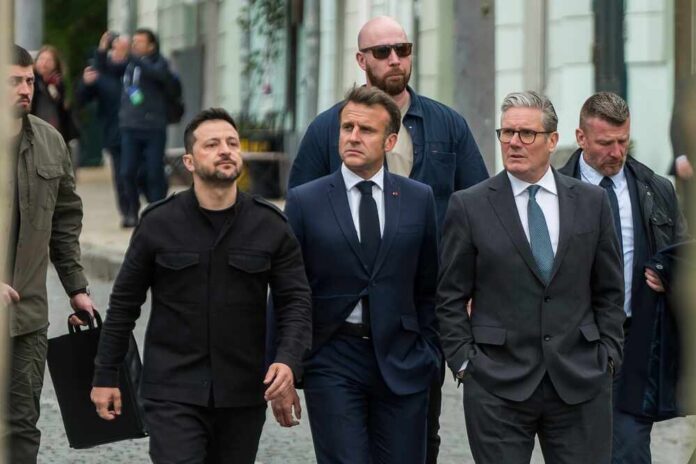
French President Emmanuel Macron convened the latest “Coalition of the Willing” summit in Paris around Bastille Day, bringing together Ukraine’s allies to focus on long-term security guarantees once a ceasefire with Russia is reached. Ukrainian President Volodymyr Zelenskyy and North Atlantic Treaty Organization (NATO) Secretary General Mark Rutte were invited to attend the July 13 meeting at the Élysée Palace, showing that Ukraine and NATO remain central to the talks. European Union leaders Ursula von der Leyen and António Costa were also expected, signaling a strong European presence.
The coalition is an ad hoc group of around thirty to thirty-five nations, led by the United Kingdom and France, that pledged to deploy a multinational force in Ukraine after a peace deal is reached. Earlier meetings in London, Rome, and Paris built this format, which aims to provide “multi-layered security guarantees” for Ukraine with support from the United States. This approach fits a broader post–Cold War pattern, where countries form temporary coalitions around specific goals instead of long, binding alliances, trading flexibility for weaker formal limits on what they can do.
What leaders are planning: troops, monitors, and industry
At a key Paris session on January 6, 2026, coalition leaders agreed in principle on several pillars of protection for Ukraine. A draft statement described a United States–led ceasefire monitoring and verification system, with coalition members contributing to a continuous, reliable truce monitoring network. Leaders also spoke of deploying units from Britain, France, and other allies on Ukrainian territory after a ceasefire, to help deter future attacks, carry out joint training, and integrate command and control systems for any multinational force.
The Élysée Palace later confirmed work on a collective plan to support Ukraine’s public finances, alongside at least €40 billion in military support pledged for 2025 to match earlier NATO commitments. Coalition meetings also discussed Ukraine’s “shadow fleet,” new military capabilities, defense industry mobilization, and deeper operational cooperation among supporting states. Macron promised that new defense initiatives and joint military exercises would be presented at the Bastille summit, with Europe taking greater responsibility for its own security posture while trying to keep the United States engaged.
Draft guarantees, limited U.S. visibility, and risks for America
Despite the ambitious agenda, much of the coalition’s work still rests on draft language and political intent, not fully ratified treaties. The January 6 Paris text spoke of “binding commitments” to help Ukraine if Russia attacks again, but even that document stated that leaders still had to formally approve the proposals later in the day. For the July 13 summit, no public joint statement had yet been released at the time of reporting, and French officials said planning for security guarantees “in case a ceasefire is reached” remains ongoing, which means detail and enforcement mechanisms are not yet fully locked in.
🌍🇹🇷 The #NATOSummit in Ankara, Türkiye brought together leaders from all 32 NATO member states to discuss collective defense, security, defense spending, Ukraine, emerging threats, and strengthening the Alliance for the future.
Hosted by 🇹🇷 President Recep Tayyip Erdoğan…
— Peace Maker (@princezar) July 8, 2026
For American conservatives, one concern is how the United States shows up in this system. Coalition records and French statements highlight European heads of state like Macron and British Prime Minister Keir Starmer, while noting that Washington often sends emissaries instead of top cabinet officials. At the same time, the Paris Declaration and draft frameworks give the United States a central technical role, such as leading ceasefire monitoring and helping design legal “solidarity mechanisms” that could trigger support if Russia attacks again. That mix of back‑room responsibility and front‑stage European leadership raises hard questions about cost, control, and accountability for U.S. taxpayers.
Sources:
unn.ua, uk.diplomatie.gouv.fr, rferl.org, facebook.com