

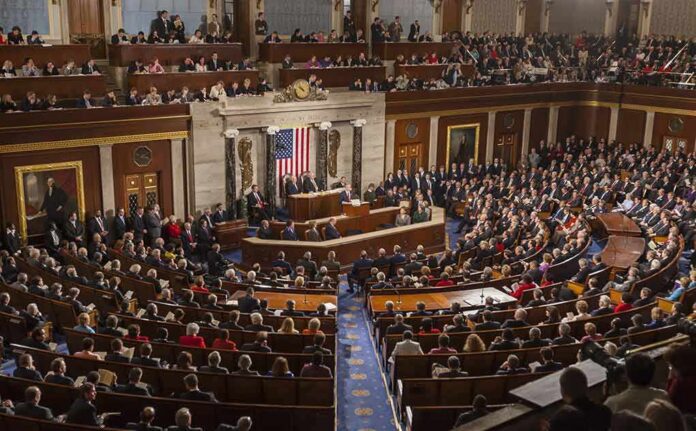
In a 215-208 vote, the House ordered President Trump to end U.S. hostilities with Iran under the War Powers law, spotlighting a constitutional showdown over who decides when America fights.
Story Snapshot
- The House passed a War Powers resolution directing a drawdown from hostilities with Iran.
- Four Republicans joined Democrats in the 215-208 vote, signaling a narrow, cross-party rebuke.
- The measure pressures the White House but does not itself end operations overnight.
- President Trump argues he retains authority as Commander in Chief to protect Americans.
What The House Ordered And Why It Matters
House leaders advanced a War Powers resolution directing President Trump, pursuant to section 5(c) of the War Powers Resolution, to remove United States forces from hostilities with Iran. The measure passed 215-208, with four Republicans joining Democrats, reflecting a slim but clear majority asserting Congress’s role in war decisions. Lawmakers framed the vote as a constitutional check and as a demand for formal authorization if hostilities continue. The resolution intensifies scrutiny of ongoing operations and costs tied to the Iran conflict.
War Powers votes test the boundary between Congress’s duty to declare war and the President’s duty to defend the nation. The 1973 War Powers Resolution set timelines for consultation and withdrawal absent authorization, but practice has been murky for decades. Legal analysts note the statute pushes consultation and accountability, even when it does not force an immediate halt to missions. The House action fits a long pattern where Congress pushes back after the executive moves first in conflict zones.
How The Trump Administration Responded
President Trump has argued he acted under his constitutional authority as Commander in Chief and Chief Executive, not under a specific statute, when he ordered strikes linked to the Iran fight. His War Powers reports cited his duty to protect Americans and preserve deterrence. The White House has said congressional moves do not strip that authority to address threats, emphasizing the need to counter Iran’s aggression and safeguard U.S. forces and partners in the region.
Administration messaging has also stressed that military actions have targeted imminent or active threats tied to the Iranian regime and its proxies. Officials point to the President’s responsibility to respond quickly when Americans are at risk. Supporters of the mission say telegraphing withdrawal emboldens Tehran and undermines leverage. They argue that Congress can authorize or fund operations but should not micromanage timing on the battlefield while troops face danger abroad.
Why Some Conservatives Backed The House Push
A small group of Republicans joined Democrats to pass the resolution, citing constitutional discipline and fiscal prudence. They argued that any sustained conflict should face a clear vote so taxpayers know the mission, scope, and exit plan. That case tracks a long tradition on the right: secure borders at home, avoid open-ended wars abroad, and keep power with the people’s representatives. The vote also reflects frustration with years of undeclared conflicts that strain families and budgets.
Some members warned that without a defined authorization, missions risk drifting, raising costs and confusion. They pressed for a debate that sets objectives and limits, rather than relying on broad claims of executive authority. That view does not oppose strength; it demands clarity, oversight, and a vote. They say a focused authorization, if needed, would send a stronger message than patchwork signals, while protecting service members and aligning power with the Constitution.
What Changes Now And What To Watch
The resolution puts formal pressure on the administration to either seek authorization or wind down hostilities. It does not, by itself, shut off operations overnight, but it raises political and legal costs for continuing without Congress on board. Next steps include potential Senate action, negotiations over authorization language, or White House consultations aimed at defining the mission. Appropriations and oversight hearings will also shape timelines and limits on future deployments.
🚨 7 GOP LAWMAKERS BROKE FROM TRUMP!
They joined every voting Democrat to pass a House war powers resolution 220-204 that would limit U.S. military operations in Iran, arguing the 60-day clock under the 1973 War Powers Resolution has already expired and Congress—not the White… pic.twitter.com/pXLHDtHaM3
— The Politic Prepper (@PoliticPrepper) September 16, 2026
For readers who value a strong military and a strong Constitution, two truths hold together. America must deter Tehran and defend Americans. America must also keep war-making tied to clear votes and goals. Congress has spoken; the President has his view of his duties. The best path is straightforward: set objectives in plain text, secure the funding openly, and hold leaders to results. That honors our troops, restrains mission creep, and keeps faith with the people’s charter.
Sources:
thegatewaypundit.com, washingtonpost.com, apnews.com, bbc.com